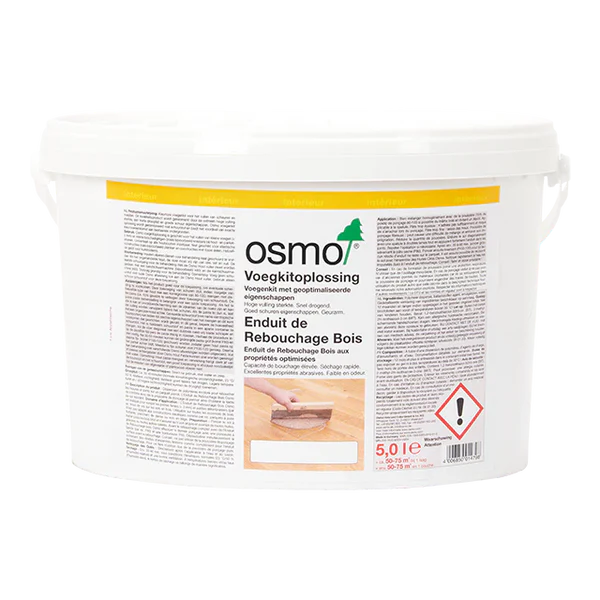
Osmo 7350 Kleurloos 5L
| Brand | Osmo |
| Gemiddeld verbruik | 15m² |
| Droogtijden | 1 uur |
| Verwerkingstijd | 0.5 uur |
| Overschilderbaar na | 1 uur |
| Schuren tussen lagen | Nee |
| Type oppervlak | Hout |
Description
Clear joint filler for filling cracks and knots in a wooden floor, wall or furniture. This quality product is characterised by its extremely high filling strength, short drying time and good sanding properties. Osmo Joint Filler is combined with sanding dust and offers the advantage of an exact colour match with existing substrates.
Using Joint Filler
Osmo Joint Filler is suitable for filling small joints (<2 mm) and small damage such as scratches on wooden floors. Before treatment, the wooden floors must be sanded back to bare wood and be free of oil, grease and dirt.
Working with Joint Filler
Mix the Joint Filler well before use to avoid separation. Add sanding dust, if possible from the same wood species with a grit size of 80-120, to make a thick paste (increase weight by approx. 15% by adding sanding dust). The right paste consistency is important. If it is too thick, there may be insufficient adhesion to the sides of the knot and the filling may be removed during sanding. If the paste is too thin, it leaves an unfilled knot. Fibrous sanding dust (especially from tropical woods) can give the mixture poor properties, so that holes and knots are not filled properly. In that case, limit the amount of sanding dust. We advise mixing sanding dust and paste in a separate container.
Fill the floor diagonally with a double-blade scraper while pressing the paste firmly into knots. Repeat if necessary. After 30-60 minutes, the dried paste can be sanded coarse (P80 grit) and then fine (P100-120) so that no paste remains on the parquet. Usually fine sanding with P100-120 is enough. The floor can then be treated with various Osmo finishes. Dirt or stains left by Osmo Joint Filler can be quickly cleaned with water.
Joint Filler coverage
1 litre is enough for approx. 10-15 m² per coat. Consumption depends largely on the properties of the wood. All information relates to smooth, planed and sanded surfaces. Other surfaces may lead to different consumption.
Joint Filler drying time
The drying time is approx. 30-60 minutes (at 23 °C/50% rel. humidity). Lower temperatures and/or higher humidity can affect the drying time.
Ventilate well during drying.
Note: the Joint Filler mixture and processing depend strongly on the wood species and sanding dust; doing a test is absolutely necessary.
Instructions for use
- Mix the Joint Filler well before use to avoid separation.
- Add sanding dust, if possible from the same wood species with a grit size of 80-120, and mix into a thick paste (increase weight by approx. 15% by adding sanding dust).
- The right paste consistency is important. If it is too thick, there may be insufficient adhesion to the sides of the knot and the filling may be removed during sanding. If the paste is too thin, it leaves an unfilled knot.
- We advise mixing sanding dust and paste in a separate container.
- Fill the floor diagonally with a double-blade scraper while pressing the paste firmly into knots.
- Repeat if necessary. After 30-60 minutes, the dried paste can be sanded coarse (P80 grit) and then fine (P100-120) so that no paste remains on the parquet. Usually fine sanding with P100-120 is enough.
- The floor can then be treated with various Osmo finishes. Dirt or stains left by Osmo Joint Filler can be quickly cleaned with water.